Image: Swettlana on Depositphotos
The Passionate Pantheon novels are all quite different from one another; not just because of the tick-tock pattern we’ve been following where odd-numbered books are upbeat and Utopian and even-numbered books are dark erotic horror, but also because each one is intentionally different in terms of theme and tone.
One thread that runs through the tapestry of the series, though, is the use of Blessings, which permeate every layer of the society of the Passionate Pantheon. So let’s talk about Blessings. And no, they’re not just drugs, at least not the way you think.
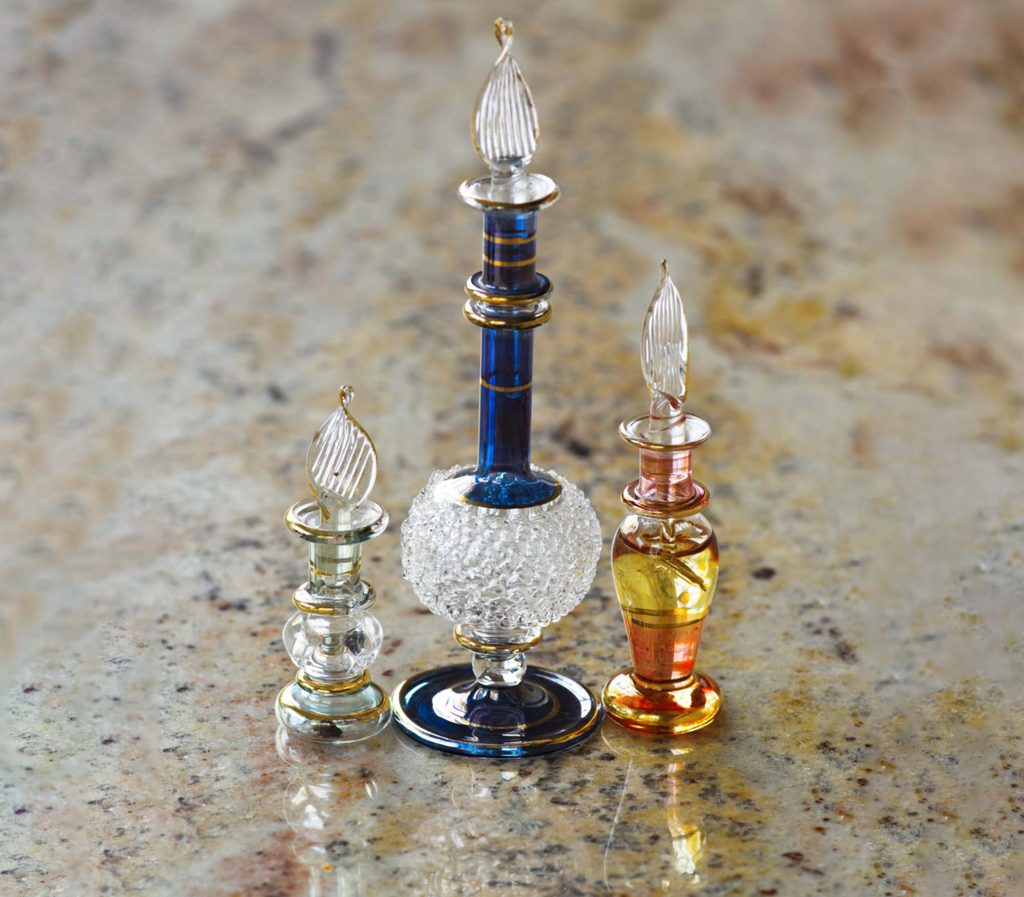
So what are Blessings? Well, superficially Blessings are packaged a bit like you would imagine very high-end, expensive drugs; they’re small, beautifully decorated vials filled with a liquid that, when consumed, alter the user’s perceptions and sensory experiences. There are Blessings that create arousal, Blessings that make the user more suggestible, Blessings that prevent orgasm, Blessings that cause spontaneous orgasms, Blessings that alter the user’s sense of the world in just about any way you might imagine.
Eventually, they came to a large ring-shaped table beneath a brilliantly colored tent made of red and yellow fabric that glowed with gentle, ever-changing light. A woman with brilliant green hair sat at a low bench in the center of the round table with an array of large flasks spread around her, each filled with glittering, shimmering liquid. She used a small pipette to mix tiny drops from the flasks into crystal vials no larger than her thumb. People sat around the table, talking, laughing, caressing. One woman sat nude on a man’s lap, grinding onto him in slow, sensual undulations.
Meesha found a space for the two of them at the table. The woman smiled at them. “What strikes your fancy?”
“What do you have?” Yaeris said.
“I have feelings beyond measure. Visions of the gods. Inner peace. Timeless euphoria. Pleasures uncounted.”
“You make all that?”
“My Festival name is Hedone. I am an artist. The realm of the subjective is my medium. I paint canvases of experience.”
“Huh. I don’t know what to say.”
Meesha beckoned Hedone close and murmured into her ear for a while. Hedone nodded. She selected two small green vials, placed them in front of her, and set about mixing the liquids from her flasks, skillfully transferring half a drop from one flask, two drops from another, a tiny droplet from a third into each of the green vials. Meesha beamed at Yaeris. “What are you up to?” Yaeris said. Meesha winked.
Hedone worked for a while, mixing and measuring. She carefully stirred the contents of the vials with a thin rod. She raised one of the vials to her nose and sniffed, then added a nearly imperceptible amount of liquid from a flask that sat at one edge of the table to each vial. She lifted one of the vials to her nose again and smiled. She handed both vials to Meesha, who passed one of them to Yaeris.
Yaeris studied the vial. Flecks of different colors—red, blue, yellow, silver, and green—swirled gently in an almost colorless liquid. She raised it to her nose but smelled nothing. “What will it do?”
“Let’s find out.” Meesha drank the liquid in her vial.
Yaeris hesitated for a tiny instant, then did the same. As she swallowed the sweet, slightly tangy liquid, Yaeris had a momentary flash of sitting in a small, cozy room warmed by a cheerful fire in a fireplace, watching through a large window while snow drifted down outside. Then it was gone.
“How long have you worshipped the Lady?” Meesha asked.
“Not long. Ten years or so. I worshipped the Quickener for a little while before that, but really, I’ve always felt torn between the Lady and the Beckoner. I allowed myself to be brought in to the Temple of the Beckoner during Collection a while ago, and, well…” She grinned. “It was intense.”
“I don’t know a lot about the Beckoner,” Meesha said. “What is worship like?”
“Interesting. I had no idea what to expect.”
“Do you often do things without knowing what to expect?”
“Yes. It makes life more memorable.”
As they talked, the contents of the vial crept up slowly on Yaeris. The bustle of the Festival faded away, until it seemed that she and Meesha were alone in all the world. She found herself entranced by Meesha, the lilt of her voice, her expressions, the way she moved. She fell into Meesha’s amber eyes, still swallowed by her great dark pupils. Meesh’s hand rested on her knee. Tiny whorls of sensation rippled through her body from that one small touch. Everything beyond Meesha’s shining form dimmed, dreamlike and insubstantial. Every tiny motion Meesha made, every smile, every laugh, felt imbued with secret meaning.
Meesha returned her gaze, just as rapt as Yaeris. Yaeris knew that, on some surface level, they were talking casually to each other, but their conversation seemed a distant, unimportant thing, something that took care of itself, with no need of her attention. She touched the back of Meesha’s hand and watched a slow wave of goosebumps rise along Meesha’s arm.
— from The Hallowed Covenant
It’s tempting, given that text, to think of the City as a society of constantly-intoxicated hedonist junkies. But that’s looking at Blessings through the lens of modern Western war-on-drugs Puritanism. If you try to understand it through the frame of Purity Culture, you will fail to understand the core of how the society of the City is built. Purity, and the attempted control that it is built on, is not how the City thinks about anything.
We have a long history of deep skepticism toward any mind-altering substances, mostly from the Calvinist idea that pleasure must be earned (and so of course drugs are a shortcut used by people who aren’t worthy because they haven’t endured sufficient suffering first) and the Puritan suspicion of any pleasure at all. Some people suggest that they base their suspicion on purely medical reasons, but if you dig down through the layers of inconsistency, you’ll find that professed concerns about safety and addiction are often a rationalization for the same morality that lies at the base of those professed beliefs.
That’s the total opposite of how the City sees Blessings.
Again: Blessings in the City aren’t drugs. While we don’t go into the technical details of how they work in the novels, they’re not chemical intoxicants, they’re microscopic programmable nanomachines that interface directly with the user’s brain to create whatever sensations or effects have been programmed into them. Effectively, they can produce any subjective experience the designer desires.
The Blessings serve important functions in the City. They’re part of most of the City’s religious rituals but they’re also used outside of Temple rituals, they’re designed and created by artists who share them with anyone who wants them…and in every case, they’re always used to promote connection and relationships. Sometimes with another person, sometimes within a group, and sometimes with something wider, more expansive and godlike (and remember, they have direct experience that their AI gods really exist!)
In the real world, recreational drugs are often a solitary experience. “Drug user” conjures images of a heroin junkie in some flophouse somewhere, withdrawn into himself. Drugs are often a highly solitary experience. In the City, people rarely take Blessing alone because Blessings are designed to promote sharing, connection, and intimacy—something we see again and again in the stories.
Eunice compares Blessings to spices or herbs. We generally don’t put spices in food because we want the experience of the spice alone (or we would just ladle it into our mouths with a spoon more often); we put spices in food because we want the experience of how the spice interacts with and enhances the food. In a similar way, people of the City use Blessings to enhance their subjective experiences.
The AI gods in the City have strong values, which are both reflections of and influence the City’s values. One of those values is autonomy; the City feels, quite strongly, that individual agency and autonomy are (literally) sacred. Infringing on another person’s autonomy without consent is just about the only sin in the City…even in the Cities that permit consensual bondslavery.
Blessings are part of that sacred autonomy. Blessings permit the City’s citizens control over their own subjective experience of the world, control that can be fine-tuned in whatever ways the City’s residents might imagine. Nobody is ever obligated to use Blessings, not even for religious rituals (although it’s significantly harder to be selected to be Sacrifice if you’re not willing to do so). While we’ve not portrayed this in any of the novels (yet), anyone who wants to can even elect to be made immune to any or all Blessings.
There was an interesting scientific experiment in the 1970s in which rats were given unlimited access to cocaine at the push of a lever. Some of the rats were isolated in bare cages; others were placed in “rat parks,” rich communal social environments with toys and exercise wheels and such. The rats in the stark, isolated environment became addicted; the rats in the rich, social environment showed much less interest in cocaine.
The City is that rich park for humans. It’s a vibrant, ever-changing environment that offers endless novelty, a rich social fabric, and no end of things to do. The residents of the City live very long lives, but have infinite opportunities to avoid boredom (and frankly, the idea that longevity would inevitably create boredom is something both of us find bizarre). Partly because of this, and partly just the cultural expectations around Blessings, you don’t see people retreating into solitude to use Blessings away from other people. Blessings are inherently social, overwhelmingly used to promote social connection. People use Blessings when they are actively out socializing or communing with others, to foster and enhance that social connection.
A nude woman with long, flowing pink hair darted by, long streamers fluttering from her arms. She wore a necklace with dozens of small crystal cylinders dangling from it, each glowing with a pale luminescence, laughing as she spread her arms toward the sky. Her eyes, a pale teal so translucent they seemed almost to glow, caught Janissa’s gaze. She spun, the streamers fluttering behind her. “Hi! My name is Llywen.” She unthreaded a vial from her necklace and extended it to Janissa. “Would you like this?”
“No tha—” Janissa started to say, the words coming automatically to her lips. She stopped herself. The gem at her throat dimmed. “What does it do?”
“From the moment you imbibe until this time tomorrow,” Llywen purred, eyes bright, “when anyone kisses you, you will experience pleasure unimaginable and incomprehensible, such ecstasy that might tear away the mystery from this world and show you the true meaning of bliss.”
“That sounds like a lot.”
“It is so very much more.”
“Ooh!” Elansa grinned. “That sounds like fun. I think you should say yes.”
“That’s okay, I…” Her necklace blazed bright. “Okay, yes, that does sound kind of interesting.”
Llywen giggled. “Would you like to accept my gift of pleasure inconceivable?”
“I, um…sure.” Janissa took the small, clear vial from her fingers. The liquid within glowed like moonlight on a still deep lake. Before she could second-guess herself, she pried off the small black stopper and swallowed the liquid inside, light and sweet with a taste like honey.
“It is done,” Llywen said. “May you experience pleasure in accordance with all that you desire.” With a flutter of ribbons, she went as quickly as she’d come.
— from the as-yet-untitled fifth novel
In other words, the way the City views (and uses) Blessings is the complete antithesis of the way modern Western society sees recreational drugs. Far from “junkie hedonists” locked in their own little selfish bubbles, the City is a rich, vibrant society that prizes connection, community, agency, and individual autonomy, and the roles that Blessings play in their lives reflects that.
Amy says:
You mentioned a Blessing once, on Quora I think, that basically allowed two people to share thoughts, or open their minds to one another. I know, when I saw that, I thought it sounded very therapeutic, in some respects.
Franklin Veaux says:
The Blessing of Union! It doesn’t share thoughts, but it does share physical sensations. I think for a lot of people it might just be.